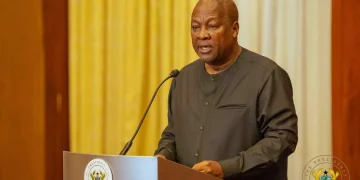



























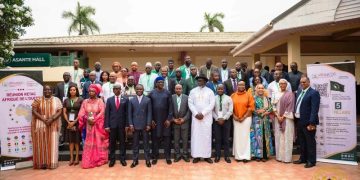



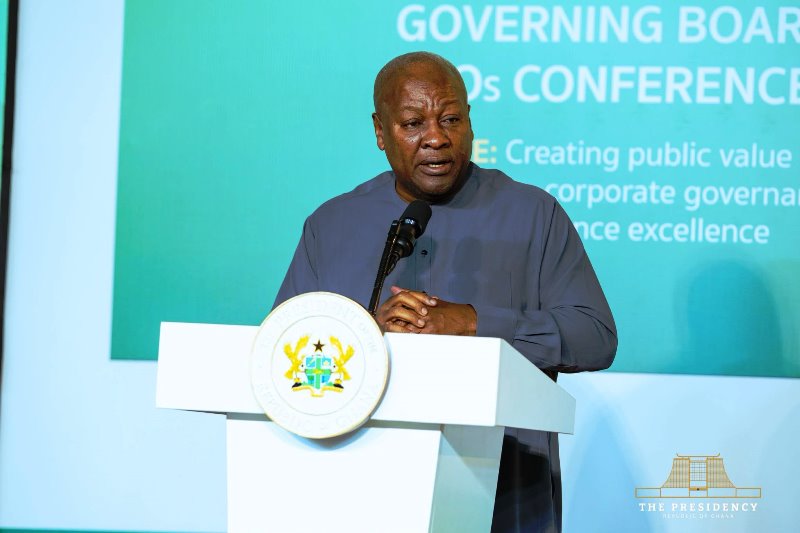
President John Dramani Mahama has challenged boards and chief executives of state-owned enterprises to prove that public ownership delivers tangible value to Ghanaians, warning that profitability alone will not be enough.


He said state assets must be managed as a public trust and not as the property of governments, boards or chief executives.
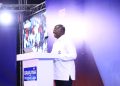
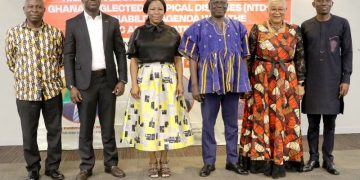
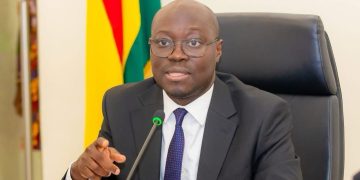
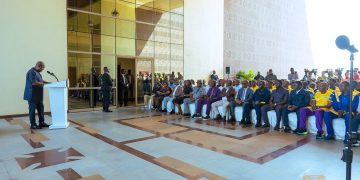
“Public ownership must produce public value,” President Mahama said at the 2026 Governing Boards and CEOs’ Conference organised by the State Interests and Governance Authority (SIGA) in Accra on Thursday.
He said ports, power infrastructure, factories, water systems, pensions, lands, buildings, equipment and state-owned shares constitute a significant portion of Ghana’s national assets and must be managed for the benefit of citizens.
“These assets do not belong to any government, a board, or a chief executive. They belong to the people of Ghana, and you and I hold them only in trust for the people,” he said.
The President said the real test of performance was not whether an institution remained operational, paid salaries or met routine obligations, but whether its activities created measurable value that ordinary citizens could experience.
“The test is therefore not whether an institution is busy, is visible, or able to meet its payroll. The test is whether it creates value that a farmer, trader, worker, entrepreneur, or student can experience,” he said.
GoldBod turnaround
President Mahama cited the Ghana Gold Board (GoldBod) as one of the state institutions whose financial performance deserved recognition.
He said GoldBod recorded a net profit of approximately GH¢896.5 million, compared with GH¢178.5 million in 2024.
“This performance reflects the strategic importance of building transparent, accountable and nationally beneficial structures around Ghana’s gold trade,” he said.
The President, however, cautioned GoldBod against relying indefinitely on favourable business conditions and exchange-rate movements, saying the gains must be supported by stronger core operations.
“These results deserve commendation but they must however be sustained through stronger core operations and cannot depend indefinitely on just a better business environment and the exchange rate movements,” he said.
TOR records major turnaround
Tema Oil Refinery also received recognition from the President after recording its first net profit in almost a decade.
According to President Mahama, TOR moved from a net loss of about GH¢745 million to a net profit of GH¢1.09 billion.
He described the turnaround as one of the notable improvements among state entities in 2025 and linked it to stronger governance and efforts to improve value delivery.
Mahama demands system-wide improvement
The President said the improved aggregate performance of state-owned enterprises must not be treated as an end in itself.
Ghana’s state-owned enterprises reportedly moved from an aggregate net loss of GH¢2.2 billion in 2024 to a net profit of GH¢19.8 billion in 2025.
President Mahama said the improvement must now translate into sustained operational efficiency, better services, stronger governance and improved returns on public investment.
He also warned that profitable state enterprises must meet their dividend obligations because returns from public investments ultimately belong to Ghanaians.
He cautioned boards and managements against using profits to fund what he described as the “creature comforts” of executives and board members.
SIGA demands stronger compliance
The Director-General of SIGA, Professor Michael Kpessa-Whyte, reinforced the President’s governance message, warning that the submission of audited accounts alone does not satisfy the accountability obligations of state entities.
He said institutions must also comply with other statutory requirements, including holding annual general or stakeholder meetings.
“An entity that files audited accounts but does not hold its annual general meeting has left a major accountability obligation unmet,” Prof. Kpessa-Whyte said.
The 2025 State Ownership Report showed significant improvement in the submission of audited accounts, with the number increasing from 53 entities in 2024 to 108 in 2025.
However, governance compliance remained weak.
Only 72 of 148 targeted entities signed performance contracts in 2025, while 71 submitted quarterly reports on time. Only 37 of 177 entities held annual general or stakeholder meetings during the year.
Prof. Kpessa-Whyte warned that such gaps could prevent government from identifying institutional risks early, potentially creating costly liabilities for the state and weakening public confidence.
The 2026 SIGA conference therefore placed renewed emphasis on moving Ghana’s state-owned enterprises beyond survival and routine administration towards measurable performance, accountability and tangible public value.
Source: www.kumasimail.com