

































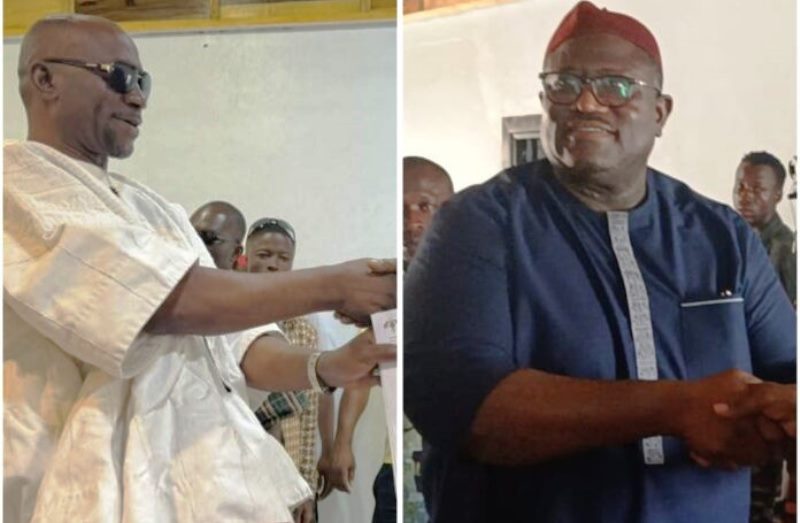
The battle for the Savannah Regional Chairmanship of the governing National Democratic Congress (NDC) is shaping up as a contest between incumbent Alhaji Imoro Seidu’s defence of his electoral record and challenger Ing. Abdul Nasser Adam’s demand for stronger grassroots structures and a more influential voice for the region in national affairs.


The two aspirants have filed their nomination forms ahead of the party’s regional executive elections scheduled for November 14 and 15, 2026, setting the stage for a contest over the direction of the NDC in the Savannah Region.
Alhaji Imoro, popularly known as Man Blessing, submitted his nomination forms at the party’s regional office in Damongo on October 15, following Adam’s filing on October 14.
While the incumbent is banking on his leadership record and the party’s improved parliamentary representation, Ing. Adam is campaigning for what he considers a more effective regional administration, with functional constituency offices, active branches and stronger grassroots participation.
The contrasting positions have brought the effectiveness of the regional party machinery into focus as the NDC prepares to consolidate its electoral gains and strengthen its structures ahead of the 2028 general elections.
Man Blessing banks on electoral gains
Alhaji Imoro’s re-election campaign centres on the NDC’s performance in the 2024 general elections, when the party won six of the Savannah Region’s seven parliamentary seats.
The incumbent has attributed the gains to his leadership and the collective efforts of regional and constituency executives, parliamentary candidates and grassroots members.
He has maintained that the party’s progress under his stewardship demonstrates his capacity to retain the chairmanship and lead the NDC towards further electoral victories.
Before filing his nomination, the chairman visited Larabanga in the West Gonja Municipality, where he sought prayers and blessings from the Chief Imam and his council of Mallams.
He subsequently paid homage to the Yagbonwura, His Royal Majesty Bii-Kunuto Jewu Soale I, at the Jakpa Palace, where he sought the traditional ruler’s blessings.
Alhaji Imoro later proceeded to the NDC regional office in Damongo, accompanied by party elders and supporters, to formally submit his nomination forms.
Speaking to the media after the filing, he expressed confidence in his chances of retaining the position, pointing to his previous electoral experience and what he described as progress made under his leadership.
He also insisted that the party remained peaceful and urged all aspirants to exercise their democratic rights without fear or favour as the internal elections approach.
His campaign is consistent with his earlier declaration that he was seeking another term to consolidate the party’s gains and improve its chances of winning the Damongo parliamentary seat, the only constituency in the region currently represented by the opposition New Patriotic Party (NPP).
Adam challenges one-man credit for NDC gains
Ing. Abdul Nasser Adam, however, is challenging the suggestion that the NDC’s electoral successes in the region can be credited to one individual.
“We all brought the government to power,” he said, emphasising the collective contribution of party members and structures to the NDC’s electoral fortunes.
The challenger expressed concern about what he described as non-functional constituency offices, inactive branches and weaknesses in the party’s organisational structures.
He argued that winning parliamentary seats and securing national political power should not be confused with building a strong and functional party organisation capable of sustaining those achievements.
For Ing. Adam, the next phase of the NDC’s development in the Savannah Region requires leadership that can mobilise members, strengthen grassroots participation and ensure that the region’s interests receive greater attention at the national level.
“Savannah has to go to the capital. Savannah doesn’t have to remain Savannah,” he stated, calling for a more assertive approach to advancing the region’s interests in Accra.
He believes the regional party leadership must do more than celebrate electoral victories and should ensure that the structures responsible for mobilising supporters remain active between elections.
The aspirant said his experience across the party’s branch, constituency and regional structures had equipped him with the knowledge needed to improve the organisation and performance of the NDC in the region.
He urged delegates to assess his candidature based on his competence, experience, commitment to accountability and ability to advance the interests of both the party and the Savannah Region.
A familiar face in the regional contest
Ing. Adam is not new to the NDC’s regional executive elections.
In 2022, he contested for the position of Regional Secretary but lost to Salisu Issifu Be-Awuribe, who secured 120 votes against Adam’s 95, according to published results from the party’s regional elections.
Alhaji Imoro, by contrast, was elected Regional Chairman unopposed in the same election.
The historical record gives the current contest an additional dimension, with Adam now challenging the man who has occupied the chairmanship since the previous regional executive elections.
However, the outcome will depend on the delegates’ assessment of the two aspirants, their campaign messages and their respective proposals for the party’s future.

Adam has also expressed confidence that his nomination forms will pass the party’s verification process. He said his team had conducted preliminary checks on its endorsers and was prepared for the vetting exercise scheduled for October 16 and 17.
The road to November
The NDC’s published electoral timetable schedules the regional executive elections for November 14 and 15, following the nomination, vetting and appeals stages.
With the two aspirants now in the race, attention is expected to focus on their ability to convince delegates that their leadership would best serve the party’s organisational needs and electoral ambitions.
For Alhaji Imoro, the central argument is continuity, backed by the NDC’s six parliamentary victories in the region.
For Ing. Adam, the priority is organisational renewal, stronger grassroots structures and a regional party leadership that can more effectively advance the Savannah Region’s interests in national decision-making.
The contest will ultimately test whether delegates prefer the incumbent’s record and promise of consolidation or the challenger’s call for a different approach to party organisation and regional influence.
Source: www.kumasimail.com