







































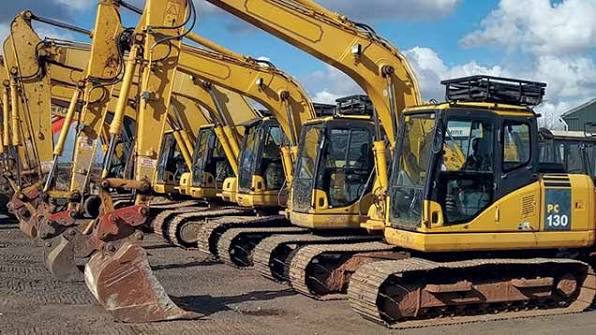
More than 4,000 excavators are currently being held at Ghana’s ports as the government tightens controls over the importation and movement of heavy-duty mining equipment in an attempt to prevent machinery from feeding illegal mining operations.


The Minister for Lands and Natural Resources, Emmanuel Armah-Kofi Buah, disclosed this during a strategic policy dialogue between the Ministry and the IMANI Centre for Policy and Education in Accra.
The new regime requires importers to provide details on who is importing an excavator, its intended end user and where the equipment will operate before clearance is granted.
The Minerals Commission has established a presence at the ports to support the verification process.
According to Armah-Kofi Buah, excavators that meet the requirements could subsequently be fitted with tracking technology and geofenced to their declared operational areas, allowing authorities to monitor their movement.
The government’s stated objective is to eventually have every excavator operating in Ghana incorporated into a traceable system.
The policy represents a significant shift in the anti-galamsey strategy—from responding to excavators after they have entered illegal mining sites to attempting to control the equipment before it reaches those locations.
Commercial importers under new scrutiny
Commercial importers who bring excavators into Ghana for resale will also be required to establish that they have legitimate orders and identifiable prospective end users.
The move is intended to close a potential loophole through which excavators could be imported without a clear destination before eventually finding their way into illegal mining operations.
It comes against the backdrop of extensive equipment seizures during operations in forest reserves.
As of July 2026, the Ministry reported that 200 excavators had been seized and another 34 immobilised.
Authorities had also seized or immobilised 2,728 pumping machines and 1,724 changfan machines.
The figures demonstrate that illegal mining is supported by a broad machinery ecosystem extending beyond excavators.
Licensing regime also faces shake-up
“People are just sitting on concessions for 30, 40 years. They are not doing anything. They are waiting for the next big investor to come so they can cash out.”
The government’s equipment-control measures form part of a broader attempt to reform Ghana’s mining sector.
Kofi Buah said government was proposing to reduce the maximum initial duration of large-scale mining leases from 30 years to 20 years.
The proposed framework would also impose tighter obligations on holders of exploration and prospecting rights.
The Minister criticised the practice of companies holding concessions for prolonged periods without meaningful exploration or development.

Under the proposed approach, licence holders would be expected to demonstrate genuine work on concessions within prescribed periods.
Communities to have a greater role
The Ministry is also proposing the establishment of District Mining Committees to give communities a greater voice in the licensing process.
Under the proposed system, applications would be considered at the district level, allowing officials and communities to examine the condition of proposed mining areas and determine whether they contain water bodies, farms, settlements or other sensitive locations.
Mining companies would also be required to enter into community development agreements.
Kofi Buah said companies should not be allowed to determine their own corporate social responsibility priorities without considering the actual needs of communities hosting their operations.
The proposed agreements are intended to create clearer and more enforceable development obligations between mining companies and affected communities.
From equipment control to traceable mining
The reforms suggest that government’s anti-illegal mining strategy is increasingly moving towards prevention and regulation rather than relying solely on field enforcement.
The 4,000-plus excavators being held at the ports therefore represent more than a customs backlog.
They are effectively a test of whether Ghana can establish a system in which heavy mining equipment has a verifiable owner, legitimate end user and traceable operational location before it enters the country’s mining ecosystem.
If successfully implemented, tracking and geofencing could make it more difficult for legally imported equipment to be diverted into unauthorised mining areas.
But the policy will also face the challenge of enforcement after clearance.
A tracking system can identify where an excavator is supposed to operate, but its effectiveness will ultimately depend on whether authorities act when equipment moves outside its approved zone.
For the government’s broader mining reforms to succeed, therefore, the system will have to connect port controls, equipment tracking, licensing, community oversight and field enforcement into one functioning regulatory chain.
Source: www.kumasimail.com