

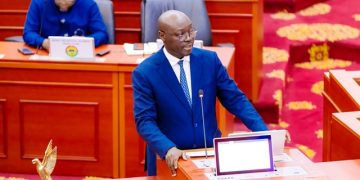
























Ghana has paid GH¢10.8 billion to holders of bonds restructured under the Domestic Debt Exchange Programme (DDEP), Finance Minister Dr Cassiel Ato Forson has announced, describing the payment as evidence of the country’s return to timely debt servicing after the financial crisis that forced the restructuring of its domestic debt.


“GH¢10.8 billion has been paid to DDEP bondholders!” Dr Forson said in a Facebook post. “Yesterday, Ghana paid its bondholders on time, in cash and in full! Four years ago, Ghana could not pay and had to restructure its debt.”
The payment, amounting to GH¢10,816,840,318.26, was made on August 18, 2026, when the latest DDEP coupon fell due. It brings the total amount paid to DDEP bondholders since 2025 to GH¢41.36 billion, according to the Ministry of Finance.
The latest settlement marks the seventh coupon payment under the debt exchange programme and the third to be paid entirely in cash, without a Payment-in-Kind component. It follows the GH¢10 billion coupon payment made in February 2026, which was also settled fully in cash.
For the government, the payment represents an important shift from the circumstances that led to the DDEP in the first place: Ghana is now meeting its restructured domestic debt obligations as they fall due.
But while the latest payment strengthens the government’s claim of improved fiscal capacity, it does not mark the end of Ghana’s domestic debt challenge. The country faces substantially larger principal repayments in the years ahead.
How Ghana got to the DDEP
The DDEP was introduced in December 2022 against the backdrop of a severe fiscal and debt crisis. Years of heavy borrowing, high debt-servicing costs, fiscal pressures and a sharp deterioration in investor confidence had left the government struggling to meet its obligations.
Ghana’s debt position had become so strained that the government sought an International Monetary Fund (IMF) programme and needed to demonstrate that its debt was sustainable before securing financial support.
The domestic debt exchange was therefore designed to reduce the government’s immediate debt-servicing burden by exchanging existing domestic bonds for new securities with longer maturities and revised interest-payment terms.
The programme, launched on December 5, 2022, initially targeted about GH¢137 billion of domestic debt. The exchange offered holders new government bonds with maturities extending into the 2030s, replacing existing obligations that were coming due much earlier.
The process was contentious, particularly among individual bondholders and institutional investors who faced significant changes to the original terms of their investments.
Nevertheless, the government announced in February 2023 that the exchange had closed with more than 80 per cent participation among eligible bonds.
The restructuring subsequently became a critical component of Ghana’s broader debt restructuring programme and the IMF-supported economic recovery programme. The IMF has said the domestic debt restructuring generated significant debt-service savings and helped reduce the present value of Ghana’s public debt burden.
From restructuring to repayment
The significance of the latest GH¢10.8 billion payment is therefore that Ghana has moved beyond the most disruptive phase of the DDEP and is now servicing the replacement bonds.
The government has sought to demonstrate that fiscal consolidation has restored its ability to meet its obligations without resorting to the kind of emergency debt restructuring that characterised the 2022–2023 period.
However, the more difficult test is approaching.
According to Dr Forson, GH¢58 billion in DDEP bonds will mature in 2027, while another GH¢53 billion will fall due in 2028. In total, Ghana will therefore face approximately GH¢111 billion in DDEP principal repayments over the two-year period.
The first major maturity is scheduled for February 2027, making preparations for principal repayment arguably the most important next phase of the programme.
To deal with this looming debt wall, government has established and begun building a DDEP Sinking Fund.
As of July 22, 2026, the fund had accumulated GH¢15.6 billion, with government targeting a balance of GH¢30 billion by the end of 2026. Dr Forson says the amount will be sufficient to meet the approximately GH¢30 billion DDEP maturity falling due in February 2027.
Under the government’s medium-term debt strategy, seven per cent of non-oil tax revenues, together with proceeds from domestic bond issuances, is being committed to the Sinking Fund Cedi Account.
What remains for Ghana
The latest payment is a positive development, but the ultimate measure of the DDEP’s success will extend well beyond the timely payment of coupons.
Ghana must first ensure that it can meet the GH¢111 billion in principal repayments due in 2027 and 2028 without creating another liquidity crisis or resorting to excessive new borrowing.
The government must also continue accumulating the sinking fund and maintain the fiscal discipline required to prevent a return to the debt accumulation that contributed to the 2022 crisis.
This will be particularly important as Ghana’s access to the domestic bond market normalises. The government will need to balance the need to finance development and manage maturing obligations against the risk of accumulating fresh debt at unsustainable levels.
The broader objective is therefore not merely to complete the DDEP payments, but to restore long-term debt sustainability and investor confidence while ensuring that government can finance its programmes without repeatedly resorting to debt restructuring.
For now, the GH¢10.8 billion payment provides evidence that Ghana is meeting its immediate DDEP obligations. But the much larger test lies ahead: whether the country can convert improved fiscal performance into enough sustained revenue and liquidity to redeem the restructured bonds when their principal falls due.
In that sense, the DDEP story has entered a new chapter. The question is no longer whether Ghana can restructure its domestic debt; it is whether Ghana can successfully repay it.
Source: www.kumasimaiil.com