




































The Minority in Parliament has opposed the approval of three nominees for appointment to the Supreme Court, arguing that the vetting process was rushed and failed to comply with several provisions of the 1992 Constitution and Parliament’s Standing Orders.


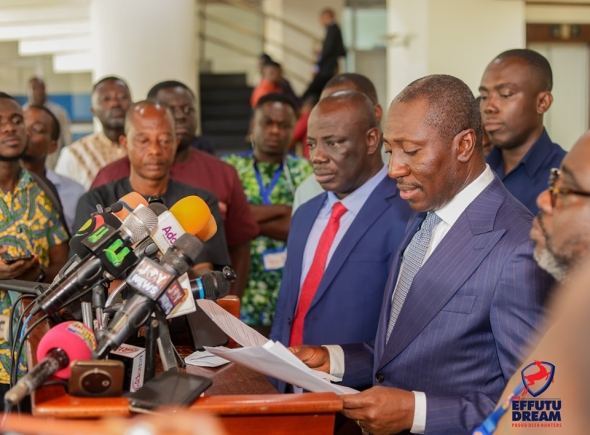
The Minority’s position was presented on the floor of Parliament during debate on the report of the Appointments Committee on the vetting of Justice Sophia Bernasko Essah, Justice Amoako Asante and lawyer Tony Forson.
The Minority spokesperson said the objection was not directed at the qualifications, competence or character of the nominees, but at what he described as defects in the process leading to their consideration by Parliament.
According to the Minority, the three judicial nominees and two ministerial nominees were referred to the Appointments Committee on Monday, leaving the Committee only three working days to complete the vetting before the end of Parliament’s emergency recall.
The Minority said it raised a preliminary objection before the judicial nominees were vetted but withdrew from the Committee after the objection was dismissed.
The Minority subsequently declined to support the Committee’s report and argued that the report was produced by Majority members after its withdrawal.
Nine grounds
The Minority outlined nine grounds for opposing the process.
First, it argued that there was no vacancy on the Supreme Court and, therefore, no emergency requiring the accelerated consideration of the nominees.
Second, it cited Order 217(11) of the Standing Orders, arguing that the provision requires a Committee to report within three days of concluding its work, rather than within three days of receiving a referral.
The Minority also cited Order 267(4), which it said allows a Committee up to three months to report on a matter referred to it.
Third, it argued that Order 217 requires the relevant subject committee leadership to participate in the vetting process and places a 15-member limit on the Appointments Committee.
The Minority said combining the vetting of three judicial nominees and two ministerial nominees within three days undermined the expertise and procedural safeguards contemplated by the Standing Orders.
Fourth, it raised concerns over the alleged failure to publish the names of the judicial nominees in the newspapers to allow members of the public and the legal profession to submit memoranda.
According to the Minority, no such publication was made before the vetting.
It further argued that this deprived members of the public and professional bodies of an opportunity to provide information that could assist the Committee in assessing the nominees.
Fifth, the Minority contended that relevant Standing Orders could not be suspended merely through the adoption of the Business Statement.
It argued that under Order 3(1), suspension of a Standing Order requires a motion, the leave of the House and the statement of reasons before the suspension takes effect.
Sixth, it questioned whether the constitutional requirements under Article 144(2), including advice from the Judicial Council and consultation with the Council of State, had been confirmed on the record before the nominees were vetted.
Seventh, the Minority invoked Article 296, which requires discretionary powers to be exercised fairly, candidly and without arbitrariness.
It argued that the compressed timetable was based on convenience rather than a demonstrated emergency.
Eighth, it said the Speaker’s explanation for recalling Parliament should not be interpreted as directing the House to rush through the matters before it.
Ninth, it raised concerns about the long-term consequences of judicial appointments, citing Article 146 and the constitutional safeguards governing the removal of Supreme Court judges.
Minority rejects discrimination argument
The Minority also rejected the Appointments Committee Chairman’s argument that considering the ministerial and judicial nominees on different timetables would amount to discrimination.
It argued that the two categories of appointments were fundamentally different under the Constitution.
According to the Minority, ministers serve at the pleasure of the President and may also be removed through parliamentary procedures, while Supreme Court judges enjoy constitutional protection from removal except through the process prescribed under Article 146.
It therefore maintained that applying different procedures or timelines to the two categories of nominees would not amount to discrimination.
Accusations of political inconsistency
The Minority further accused the governing side of abandoning positions it had taken while in opposition.
It referred to parliamentary proceedings in 2024, when members of the then Minority, including the Member for Bawku Central, Mahama Ayariga, raised objections to the process for considering Supreme Court nominees.
The Minority argued that the conduct of the current Majority was inconsistent with the position taken by some of its members when they were in opposition.
It described the situation as a question of political convenience rather than principle.
Business Statement dispute
The Minority also challenged the argument that Parliament’s adoption of the Business Committee’s report had effectively authorised the compressed timetable.
It said the Business Statement was primarily a scheduling instrument and did not amount to an automatic suspension of Standing Orders.
According to the Minority, accepting such an interpretation could create a precedent under which parliamentary rules could effectively be set aside simply by scheduling particular business.
Minority threatens legal challenge
The Minority said it would not lend its support to the approval proceedings if Parliament proceeded with the Committee’s report despite the objections raised.
It further indicated that it reserved the right to invoke Article 2 of the Constitution and seek a determination from the Supreme Court on the legality of the process.
The Minority called for its objections to be fully captured in the Official Report, saying the record should reflect its reasons for withdrawing from the Committee’s proceedings and opposing the approval of the nominees.
The statement concluded with an appeal for Parliament to uphold constitutional principles and parliamentary procedure, stressing that the Minority’s objection was directed at the process and not the individual nominees.
The Appointments Committee’s report, however, was presented to Parliament for consideration, with the Committee’s majority decision forming the basis of the approval process.
Source: www.kumasimail.com