



























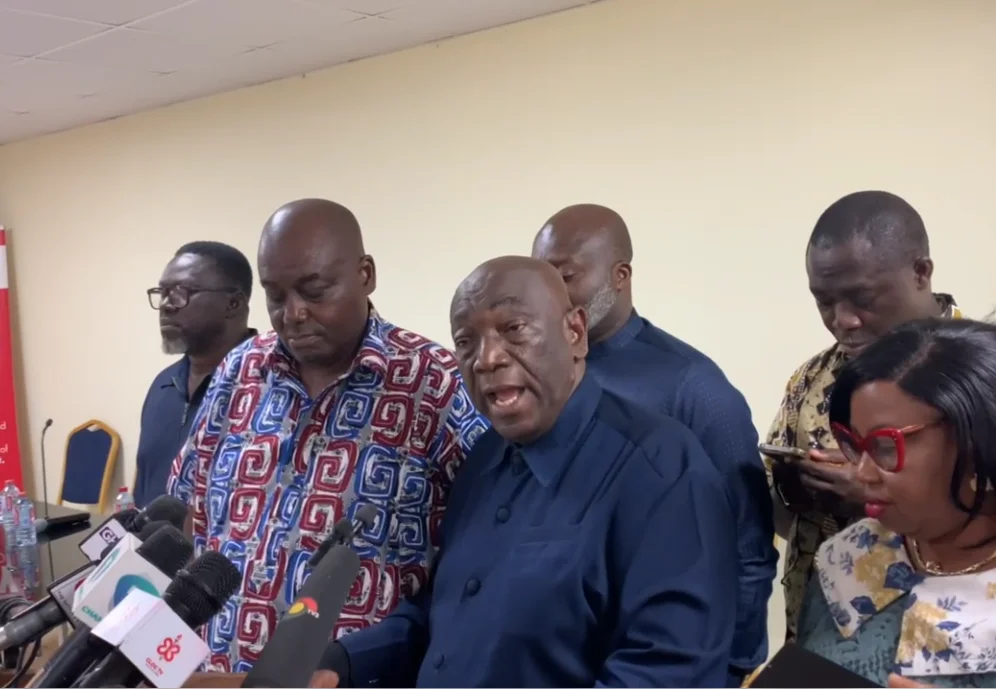
The Trades Union Congress (TUC)-Ghana has rejected plans for private sector participation (PSP) in the operations of the Electricity Company of Ghana (ECG) and the Northern Electricity Distribution Company (NEDCo), describing the initiative as privatisation of Ghana’s electricity distribution sector.


In a statement signed by its Secretary-General, Joshua Ansah, the TUC accused the World Bank of deliberately downplaying the extent of the proposed private sector involvement by describing it as an operation focused only on revenue collection.
The union’s reaction follows comments by the World Bank Country Director, Dr Adrian Alter, on Channel One Television on August 24, 2026, concerning the proposed PSP arrangement.
According to the TUC, the model being proposed by the transaction adviser appointed with the backing of the World Bank and the International Monetary Fund (IMF) would allow private operators to take responsibility for electricity distribution from the Bulk Supply Points of the National Interconnected Transmission System to final consumers.
The union said under the proposed arrangement, ECG and NEDCo would retain ownership of the distribution assets, while private operators would lease and operate the networks.
The private operators, it said, would undertake both technical and commercial functions, including billing, revenue collection, customer management, network maintenance and loss reduction.
The TUC therefore argued that the arrangement amounted to privatisation, despite assurances that the assets themselves would remain publicly owned.
“The World Bank is aware of this model. It is shocking for the Bank to say otherwise,” the statement said.
The union also criticised the World Bank and IMF for what it described as their continued focus on distribution losses while allegedly paying insufficient attention to the cost implications of Ghana’s Independent Power Producer (IPP) arrangements.
It argued that the IPP model had contributed to high electricity generation costs, particularly because of foreign exchange exposure and dollar-denominated contractual obligations.
The TUC further cited Uganda’s experience with UMEME as an example of the potential consequences of private participation in electricity distribution. It claimed that an arrangement that initially involved distribution eventually resulted in extensive control by the private operator and higher electricity costs.
The union also questioned the World Bank’s position on cost-reflective electricity tariffs, arguing that greater attention should be paid to high generation costs and the financial burden created by power purchase agreements.
It called on the World Bank to comment on what it described as the controversy surrounding the previous ASKA Energy Power Purchase Agreement.
The TUC also invoked Ghana’s experience with privatisation under the Structural Adjustment Programme, saying more than 100 state-owned enterprises were privatised under World Bank-supported reforms.
According to the union, those reforms resulted in significant job losses and social disruption, contrary to expectations that the private sector would replace employment lost through the restructuring of state enterprises.
The TUC maintained that decisions concerning strategic national assets must remain within the authority of the Ghanaian government and people.
“Ghanaians voted for a Ghanaian government to run the country including running the Electricity Company of Ghana,” the statement said, adding that the country’s sovereignty over strategic assets “cannot be outsourced to any strategic advisor.”
The union reiterated its opposition to PSP in ECG and NEDCo and said it regarded private sector participation and privatisation as effectively the same under the proposed arrangement.
It warned that the TUC and its affiliates would take all lawful measures necessary to prevent what it described as the privatisation of Ghana’s electricity distribution sector.
“We will do whatever it takes legally to stop the privatisation of ECG and NEDCO,” the statement concluded.
Source: www.kumasimail.com