









































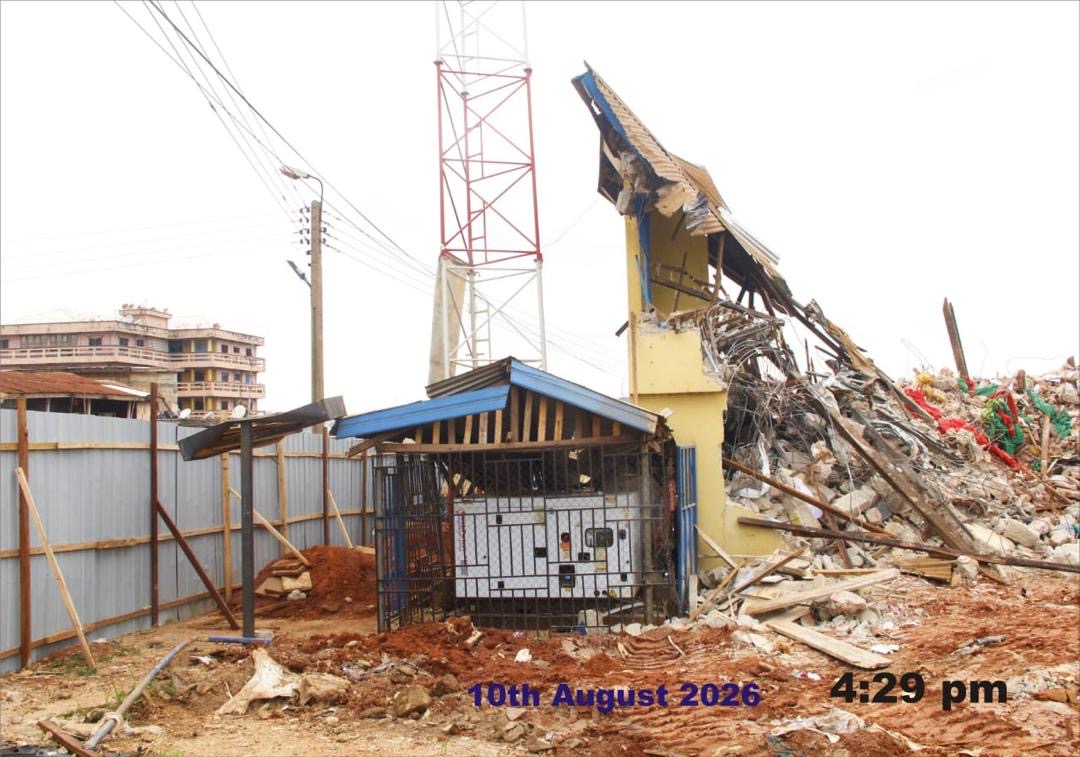
The demolition of the Aboabo branch of Sekyedumase Community Bank PLC has introduced a potential compensation dispute into the Asokore Mampong Municipal Assembly’s redevelopment of the Aboabo Market into a 24-hour economy facility.


The development has raised questions over whether the Assembly’s decision to remove the bank from the project site could expose the public purse to a compensation claim, particularly as the bank maintains that it had not completed the process of relocating its operations when the building was demolished.
The dispute centres partly on a tenancy agreement dating back to 2003, which allows the Assembly to revoke the bank’s licence where national or public interest requires it, but provides that such revocation should be carried out “with notice.”
Documents sighted by this publication show that the Assembly had been engaging the bank since 2025 over the redevelopment of the market and the need to relocate the branch.
The bank, however, argued that earlier discussions had included the possibility of incorporating its existing one-storey building into the ongoing 24hour Market project.
At a meeting on November 28, 2025, the bank said it was informed that consultants would assess whether the structure could be retained as part of the new 24hours market design.
The bank subsequently renewed the proposal, stressing that its Aboabo branch serves as a financial hub for traders, transport operators, small businesses, salaried workers and residents in the municipality.
It also told the Assembly that relocating a banking facility was not a simple process, requiring technical and security assessments, regulatory approvals, Board approval, installation of banking infrastructure and the secure transfer of customer records and other assets.
The bank therefore requested sufficient time to complete the relocation.
The Assembly rejected the proposal, maintaining that the final architectural and engineering designs for the redevelopment did not allow for the retention or integration of the existing bank building.
Final notice
In a letter dated June 15, 2026, the Assembly issued what it described as a “Final Warning to Vacate the Aboabo Market Redevelopment Site,” giving the bank five days to vacate the premises.
It warned that failure to comply would result in the Assembly taking “all lawful measures necessary” to recover possession of the site and proceed with the redevelopment.
The bank subsequently protested the manner in which the eviction process was being carried out after contractors began placing laterite and other construction materials at the entrances to the premises.
According to the bank, the action disrupted its operations and was followed by the disconnection of electricity to the building.
It also expressed concern about the safety of its assets, noting that the premises contained customer information, banking equipment, computers, furniture, records and other valuable items.
In correspondence to the Assembly and institutions including the Ashanti Regional Coordinating Council, Bank of Ghana, ARB Apex Bank and the Ashanti Regional Police Command, the bank warned that demolishing the structure without a proper inventory and safeguards could have serious consequences.
The bank said it would assess the cost associated with relocating the branch and submit a claim to the Assembly for what it considered fair and adequate compensation.
Potential legal implications
The disagreement could ultimately turn on whether the tenancy arrangement was properly terminated, whether sufficient notice was given and whether the bank suffered compensable losses as a result of the demolition.
Financial consultant Dr. Solomon Aggrey, commenting on the matter in a media interview, said the development could have implications for the Assembly if the dispute proceeds to court.
“This disagreement therefore goes beyond the physical destruction of the building and could potentially centre on whether the contractual arrangement was properly terminated, whether adequate notice was given and whether the bank suffered losses for which it is entitled to compensation,” he said.
He, however, noted that the matter would not automatically constitute a judgment debt.
“Any such claim would have to be determined through the appropriate legal process. It would only become a judgment debt if a court ultimately rules in favour of the bank and orders the state or the relevant public authority to pay compensation,” Dr. Aggrey explained.
The Assembly, for its part, has maintained that it engaged the bank repeatedly and issued notices as part of the process to secure the site for redevelopment.
The bank’s position remains that it required adequate time to obtain the necessary regulatory approvals and complete a lawful relocation before the demolition.
24-hour economy project
The demolition forms part of a broader redevelopment exercise aimed at transforming the Aboabo Market into a modern 24-hour economy market.
Hundreds of structures at the market were demolished in May to make way for the project, with the Assembly saying the redevelopment would provide modern trading infrastructure and stimulate economic activity in the area.
The proposed facility is expected to include sheds and lockable shops, parking facilities, police and fire service posts, a 24-hour clinic and pharmacy, a daycare centre and a Women’s Bank component.
The Aboabo project is part of the government’s broader 24-Hour Economy and Accelerated Export Development Programme (24H+), which seeks to extend productive economic activity beyond conventional working hours, improve market access, increase productivity and create employment.
The 2026 Budget describes the 24-hour economy as a productivity-focused programme intended to accelerate industrialisation, boost exports and create more than 1.7 million decent jobs by 2028 across sectors including agriculture, manufacturing, logistics and services.
The programme received statutory backing after President John Dramani Mahama assented to the 24-Hour Economy Authority Bill, 2025, in February 2026. The Authority is expected to coordinate implementation and align public and private sector efforts towards the programme’s objectives.
For the Asokore Mampong Assembly, however, the demolition of the Sekyedumase Community Bank has added a legal and financial dimension to the redevelopment.
Whether the matter results in a compensation claim — and ultimately a judgment debt — will depend on how the contractual and legal issues surrounding the bank’s occupation, notice and demolition are resolved.
Source: www.kumasimail.com