



































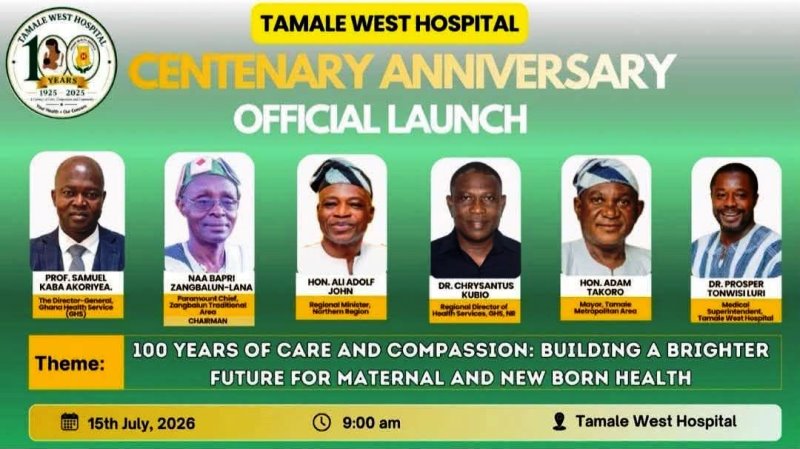
A promotional flyer for the launch of the centenary celebrations of Tamale West Hospital has triggered a wave of criticism from gender advocates, journalists and social commentators over the absence of women among the event’s announced speakers, despite the programme focusing on maternal and newborn health.


The launch, scheduled for Saturday, July 18, 2026, at the Tamale West Hospital premises, will be held under the theme, “100 Years of Care and Compassion: Building a Brighter Future for Maternal and Newborn Health.”
According to the flyer, the speakers are Dr. Samuel Kaba Akoriyea, Director-General of the Ghana Health Service, Naa Bapri Zangbalun-Lana, Paramount Chief of the Zangbalun Traditional Area and retired medical doctor, Ali Adolf John, Northern Regional Minister, Dr. Chrysantus Kubio, Northern Regional Director of the Ghana Health Service, Alhaji Abubakari Adam Takoro, Metropolitan Chief Executive of Tamale, and Dr. Prosper Tonwisi Luri, Medical Superintendent of Tamale West Hospital.
The absence of a single female speaker drew attention after Professor Wegeiwor Aseweh Aboh of the University of Ghana Business School shared the flyer on social media late Wednesday with the caption: “They will be discussing maternal and new born health. Details on the flyer please. Thanks.”
Within hours, the post generated widespread reactions, with many questioning why women were excluded from a platform dedicated to issues that directly affect mothers and newborns.
Entrepreneur and gender advocate Alima Bawa congratulated the hospital on reaching its 100-year milestone but questioned the composition of the panel.
“Congratulations to Tamale West Hospital on your 100th Anniversary. A century of service to humanity is no small achievement.”
She continued, “Now, unless science has made a groundbreaking discovery overnight, women are still the ones carrying pregnancies for nine months, so one would expect at least one female voice on a platform discussing maternal and newborn health.”
Bawa stressed that her concerns were not about the qualifications of the male speakers.
“This is not to question the competence of the men assembled here, they have all earned their places but are we really saying that among the many accomplished female obstetricians, pediatricians, gynecologists, midwives, nurses, public health experts, administrators and health researchers, none was worthy of sharing the stage?”
She argued that maternal health discussions should recognise both expertise and lived experience.
“Sometimes, it’s about acknowledging lived experience and expertise, not even on a gender lens.”
Using humour to underscore her point, she added:
“A conversation about maternal and newborn health without a woman’s voice feels a bit like organizing a national jollof competition and forgetting the rice.”
Bawa concluded by calling for greater visibility for women.
“As we celebrate 100 years of caring for mothers and babies, let’s also celebrate the women who have dedicated their lives to that mission on decision-making platforms… If we are central to the story, then we should also be visible in the character.”
Another gender advocate, Tua Fouzia Alhassan, Team Lead at Wakati, echoed similar concerns.
“Nothing about women without women. No buts, no excuses, just representation!”
Alhassan acknowledged that organizers had responded to earlier criticism elsewhere but maintained that representation remained the central issue.
“It is deeply concerning that a launch centered on maternal and newborn health decided to feature an all-male panel of speakers.”
She added that while the invited speakers possessed extensive experience, there were equally competent women whose voices deserved to be heard.
“The speakers lined-up have a wealth of experience but there are equally qualified female health professionals, midwives, nurses, researchers and mothers who can bring lived experience and professional expertise that are essential to shaping meaningful conversations on maternal health.”
According to her, Tamale West Hospital should have intentionally included women.
“After 100 years of existence, there should be enough evidence of the role of women in maternal and newborn care. No?”
Journalist and blogger Mumuni Yirifa Yunus, also questioned the credibility of discussing maternal health without female representation.
“A maternal health panel entirely lacking a woman is fundamentally disconnected from the very reality you seek to address.”
He argued that although the speakers possess medical expertise, they cannot replace the perspectives of women with lived experiences.
“While your panel has distinguished medical expertise to provide clinical data and anatomical facts, they cannot be a substitute for the lived experience of pregnancy, childbirth and postpartum recovery.”
Yunus further stated that excluding women risks reducing maternal health discussions to what he described as “a sterile, academic exercise, stripping the event of its credibility and relevance.”
He also pointed out that Tamale has female professionals with both academic credentials and practical experience who are capable of leading such conversations.
“Tamale equally has mothers who have lived experience of maternal related issues and also have distinguished medical and academic expertise in maternal health issues and can competently lead conversations centered on data and anatomical facts on maternal health.”
Despite his criticism, he wished the hospital a successful centenary celebration.
Gender advocate Bashiratu Kamal-Muslim described the all-male line-up as disrespectful to the women whose experiences would be discussed.
“Dear Tamale West Hospital, this is not just shameful, but really disrespectful to the women and children whose lived experiences are going to be discussed.”
She questioned why frontline maternal health professionals were absent from the programme.
“Where are the professionals who are the direct contact persons on these issues at the hospital?”
She further wrote:
“No one single midwife, no one single patient, just privileged people going to speak over the marginalised on their issues as usual.”
Ending her post with a rhetorical question, she asked:
“What is the cost of life?”

The controversy has reignited broader conversations about gender representation in decision-making spaces, particularly in Northern Ghana, where advocates have repeatedly called for women’s expertise and lived experiences to be reflected in public discourse, especially on issues that directly affect them.
As of the time of filing this report, Tamale West Hospital management had not publicly responded to the concerns raised over the composition of the speakers’ line-up.
Source: www.kumasimail.com